

EVERYDAY
MYSTERIES
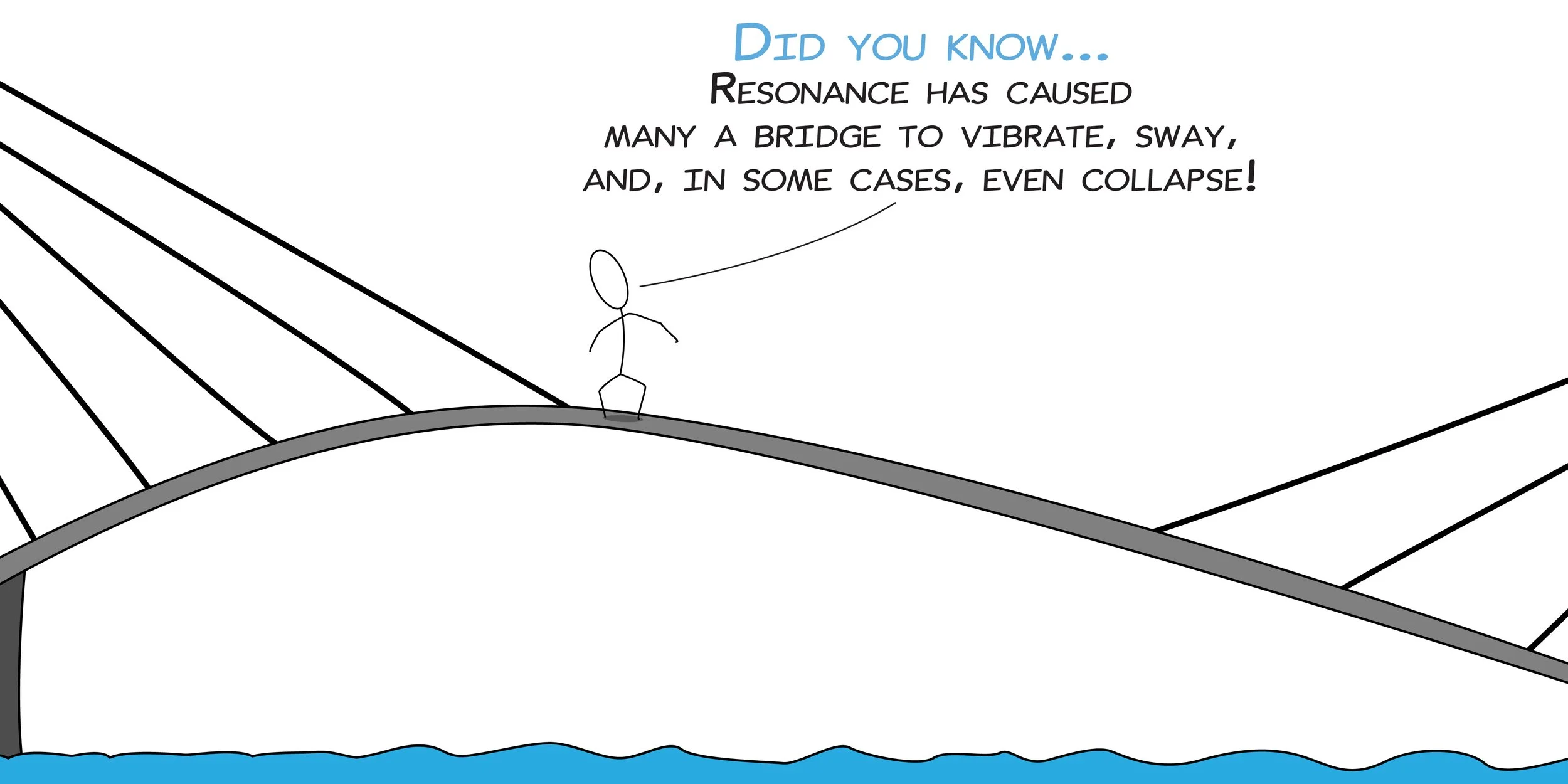
Have you ever wondered why a series of tiny pushes can send a swing soaring, or why a singer can shatter a glass with the right note? This week, we uncover the surprising science of resonance. A swing only goes higher when energy is added at exactly the right moment, and it turns out the same principle appears throughout the world around us. By exploring pendulums, standing waves, vibrating slinkies, and resonating tuning forks, our young scientists will discover how timing can make even small pushes produce dramatic effects. Along the way, we’ll investigate natural frequencies, create musical sounds from everyday objects, and see how resonance can make vibrations grow powerful enough to shake bridges, amplify music, and even send a swing soaring higher and higher.
A FANTASTIC
VOYAGE WITHIN
And so we arrive at the most complex organ in the human body: the brain. It contains billions of neurons, each communicating through a vast network of electrical and chemical signals. We begin our exploration of the nervous system by uncovering how these remarkable cells allow us to think, feel, move, and react. Our young scientists will put their own nervous systems to the test through reaction-time challenges and reflex investigations, discovering that not all responses require conscious thought. Along the way, we will explore how the brain processes sound, attention, and information from the world around us. Through auditory illusions, attention tests, and other cognitive challenges, we will discover that the brain does far more than simply receive information; it constantly interprets, edits, and sometimes even deceives us.
CHEMISTRY IN
PLAIN SIGHT
The world of polymers is about to get a little more delicious as we discover that some of the most fascinating materials are built from tiny repeating building blocks. These molecules join together to create long chains called polymers, and with the right recipe, these chains can stretch, bounce, and even be eaten! We will create our own edible slime as sodium alginate and calcium chloride link together to form long strands that can be pulled, twisted, and tasted. With a sprinkle of Skittles powder, our experiment becomes a sweet treat while revealing the hidden chemistry behind its texture. Then, we’ll transform a simple “slime” into a bouncy ball using the perfect mix of ingredients, uncovering how polymers are everywhere around us.