Issue 13 | Autumn 2025

That’s us for the term!

Thank you so much for giving us the chance to share some science and wonder with your future scientists. We have loved teaching them and can’t wait to do it again soon.

Until then, Merry Christmas and Happy New Year!

If January is too long to go without some science and wonder, join our Winter Camp by clicking here.

SCIENCE BEHIND THE WAND

Even in winter, Glacius, the freezing spell, would be really handy in Dubai, but plain old refrigeration has already worked wonders in cooling the desert. While spraying compressed air cans that cooled in our hands, we learnt how pressured refrigerants are used to chill everything from rooms to food. But it was the freezing air that came out the other end that let us cheat the laws of thermodynamics and make things really cold! By rapidly expanding pressurised gas, we made clouds in bottles and even froze carbon dioxide. At -80 degrees, this dry ice was perfect for creating enough billowing, magical fog to celebrate our graduation from the wizarding world of science.

MYTH BUSTERS

With so many myths and so little time, we end the term with a bunch of myths you don’t need a lab to debunk. Can you fold paper in half more than seven times? You sure can! Just ask Britney Gallivan, the high-schooler who not only worked out the formula for this but also holds the world record for most paper folds. Does air moving around a wing really want to reach the end at the same time? Nope. And, as our paper planes showed, there’s a lot more to flight than just Bernoulli’s principle. Does water drain clockwise in the Northern hemisphere? While there may be a tendency for this, you can easily overcome the Coriolis Effect and make water drain whichever way you like, as we did in our tornado bottles. Is the Earth round? Yes!!! Just ask Eratosthenes, who used nothing but a shadow to prove this more than 2000 years ago!

PERIODIC PIONEERS

Unlike most of the elements we have met this term, the larger, heavier ones at the tail end of the Periodic Table are ones you wouldn’t want to see up close. At least not without a few inches of lead in the way. With such large nuclei, their atoms are prone to radioactive decay, breaking down into smaller elements and a whole bunch of DNA-damaging energy and particles. Since even Googling where we could find some of these elements would put us on some watchlist somewhere, we recreated their toxic glow by shining UV light on our fluorescein potions, before breaking down luminol with some bleach to end the term basking in its ethereal light.

Issue 12 | Autumn 2025

We’ve got discounts expiring soon!

Early-bird for our Winter Camp expires on the 1st of December.

Book here using the code WC10 to get an additional 10% off the week!

And the preorder window for our Christmas Science Kit closes on the 1st as well.

Preorder yours here and get the Kit at a special discounted price!

Don’t miss out on this chance to save.

SCIENCE BEHIND THE WAND

While the wizarding world need only utter “Ventus” to blow great, big gusts, we muggles need to rely on ungainly fans to push air around. But Bernoulli’s principle gives a way to get so much more out of our fans. After using the power of pressure differentials to defy gravity and stop an upturned cup of water from pouring onto the floor, we will explore the relationship between air’s speed and pressure. Using fast-moving air to reduce pressure, we will get the surrounding atmosphere to give us a helping hand. Balls will be sucked right out of cups and will float midair. Water (and the toilet paper to soak it up) will be sent flying across the lab. And giant bags and entire rooms will be filled up with just a single puff of air!

MYTH BUSTERS

Does lightning never strike the same place twice? To find out, we will go deep into the world of static electricity. Using simple friction, we will dislodge electrons from everyday objects and induce charges that will make balloons attract and repel, and paper rise up and dance. But is the static behind these simple experiments also responsible for one of nature’s most magnificent sights? Our Van de Graaff generator will answer that by supercharging the charges involved, allowing us to rain down tiny lightning bolts without a storm cloud in sight. Our plasma ball will let us get up close and personal and see what happens to the air in a strike, but it’s the fierce arcs of the Wimshurst machine that will finally settle this myth!

PERIODIC PIONEERS

The post-transition metals are definitely metals, but to a lesser extent. Not only are they softer and more brittle than your typical transition metal, but they also melt at much lower temperatures, making them easier to work with. Using a blowtorch, we will melt aluminium. Using a soldering iron, we will melt tin. And using nothing but our body heat, we will melt gallium! Then, it’s time to turn up the power. By passing a current through a solution of tin salt, we will crystallise a delicate metal snowflake right out of the liquid!

Issue 11 | Autumn 2025

The Curiosity Lab Christmas Science Kit is now available for preorder!

We have pulled out all the stops to make sure this Kit is perfect for any future scientists who have made the “Nice List” this year. And since we are doing all the measuring, bottling, label-sticking, packing, and ribbon-tying ourselves, we have a very limited number of Kits available.

Preorder yours here and get the Kit at a special discounted price!

And don’t forget… Early-Bird is still on for our Winter Camp.

Book here using the code WC10 to get an additional 10% off the week!

SCIENCE BEHIND THE WAND

On a blue planet like ours, Aguamenti, the spell to create water, hardly seems needed. That is, until you discover how little of that is accessible fresh water. So in places like the desert we live in, humans have had to be more resourceful. By soaking potato strips in distilled and salt water, we will explore the process of osmosis, the movement of water across a partially permeable membrane, and its counterpart, reverse osmosis, which is how we desalinate the seas to quench our thirst. But if we really want to make water rather than filter it, we need to break it down into its components using electricity. Then, by reacting oxygen with the hydrogen in a balloon, we will create water out of thin air and a whole lot of fire!

MYTH BUSTERS

Is custard explosive? The question may seem silly, but custard factories have been known to explode! Using flint and steel to spark up a fire, we will explore the fire triangle and determine whether custard has what it takes to combust. As we roast marshmallows over our mini campfires and charm a carbon “snake” out from the sugary ashes, it will become all too clear that custard has the energy to ignite. However, for an explosion to occur, things need to get much finer. By grinding this dessert into a powder and dispersing it into our oxygen-rich atmosphere, we will blow the lids off paint cans and send sweet, fiery whooshes into the air.

PERIODIC PIONEERS

Not all Transition Metals are created equal. Some resist change so irresolutely that we covet them. We make our jewellery from them. The alchemists of the past spent their lives trying to magic them up from lesser ingredients (a task we succeed at by turning a flask pure silver!). The precious metals may be prized, but the others have a trick up their sleeves. They readily produce salts, salts which do more than flavour our food. By sprinkling a dash of these more exotic salts into a flame, we will make it burn with every colour of the rainbow.

Christmas Science Kit

Do you know any future scientists who made the “Nice List” this year? Then we have the perfect gift for them!

Santa’s Curiosity Lab elves have been busy putting together the best Christmas Science Kit ever! Inside each, you will find everything you need to carry out three of our most popular experiments, all with a festive twist.

REINDEER TOOTHPASTE

Unleash an eruption of foam as you carry out YouTube’s most popular chemical reaction from the comfort of your home.

CHRISTMAS TREE SLIME

Mutate your Christmas tree into a stretchy polymer that looks (and smells!) like the real deal.

CRYSTAL ORNAMENTS

Brighten up your Christmas Tree with ornaments crafted and crystallised by your own hand.

The Kit will have enough material to complete each experiment twice, along with easy-to-follow instruction videos and cards that will teach you all the cool science behind each one.

Our Christmas Science Kit can be yours for:

AED 300

Once ordered, Kits can be picked up from Curiosity Lab, Al Quoz. Delivery is also available within Dubai at an additional AED 30.

If the Kit wasn’t exciting enough already, make it extra special by adding on a Curiosity Lab lab coat and drawstring bag at an additional AED 100 per kit!

Since being one of Santa’s elves is only a side hustle, we have a very limited number of Kits available. So don’t miss out…

Fill out the form below and order your Curiosity Lab Christmas Science Kit now!

All prices are exclusive of VAT

Issue 10 | Autumn 2025

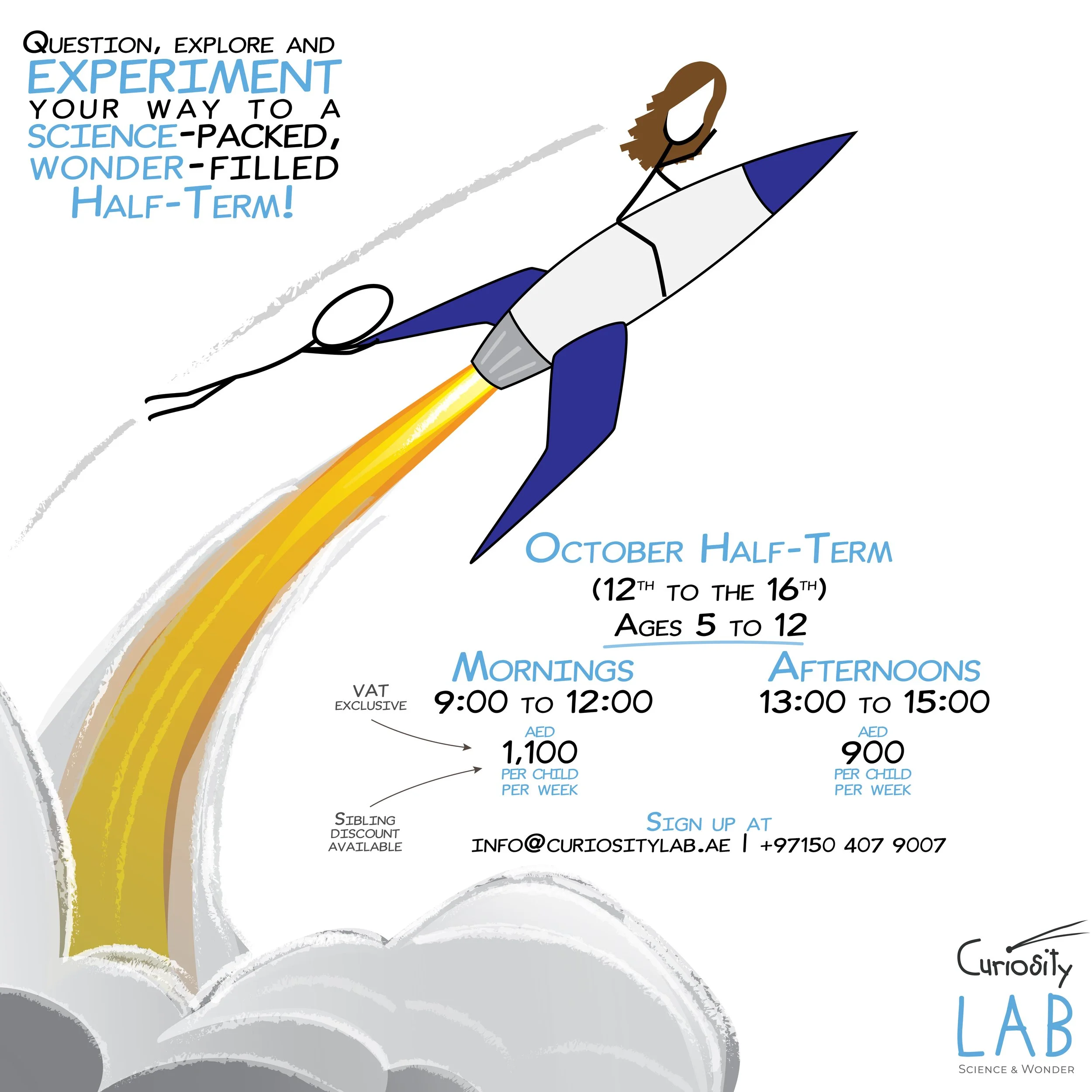
Registration for our Winter Camp is now open!

Join us as we select the best hands-on activities and experiments from our Modules, and then make the most of the free time children finally have to take it all to the next level!

The camp is suitable for children aged 5 to 12, with both morning and afternoon sessions available.

Book here before the 1st of December using the code WC10 to get an additional 10% off the week!

SCIENCE BEHIND THE WAND

While a simple “Sonorus” is enough to ensure you’re heard over even the most exciting game of Quidditch, we Muggles have to resort to microphones, speakers, and electrical amplification. But there are far more low-tech ways to make our voices heard. Using slinkies, we will visualise sound waves to better understand what amplification means, before we add a megaphone of sorts to it and amplify its rattle to a symphony of sci-fi sound effects. Then, using the power of resonance, we will get rice to dance and glasses to sing before we turn a simple PVC pipe into a flute whose tune could fill a concert hall with nothing but the air escaping our lungs.

MYTH BUSTERS

In the wild, the difference between life and death could be a simple fire. It should come as no surprise, then,  that people have come up with many resourceful ways to start a fire. Rubbing sticks. Bag of water. Polished ice. A battery and a stick of gum. So this week, we will try to turn up the heat as we explore the science behind these possible myths and then test them. Bow drills will be employed to see if wood alone has enough friction to start a fire. The refractive power of water and glass will be focused to magnify objects and burn balloons. And batteries will be short-circuited to ignite foil-covered wrappers and steel wool.

PERIODIC PIONEERS

Get ready to rock, because it’s all heavy metal from here on out. Since the metallic elements account for about 80% of the Periodic Table, it’d be good to know what makes a metal so “metal”. Is it the colour? The strength? The hardness? Its malleability? Its ductility? Or maybe it’s another property altogether? We will scour the lab for its metals and put them to the test. A barrage of tests, actually. Which of them conducts electricity? Which of them is magnetic? Only the best will help us build simple circuits and turn slime magnetic.

Winter Camp 2025

Question, explore and experiment your way to a science-packed, wonder-filled Winter

Each day, your future scientists will explore a theme that could take them from the microscopic worlds of chemistry and biology, up through the invisible fields of forces and energy, and out to the astronomical realms of planets and stars. Through jaw-dropping demonstrations and mind-blowing experiments, they will get hands-on in a way that will leave them with a thorough, conceptual understanding and a lifelong love for Science.

Kids will be split into similarly-aged groups that will work their way through the day’s activities at a level best suited for their ability. Some will have their curiosity sparked, others will have it nurtured and fuelled, and everyone will have so much fun, they'll never want to leave!

All kids need to bring is a small, healthy, nut-free snack and plenty of curiosity!

Sign up now using the Online Registration Portal below

Please note:

  • There will be no camp on Christmas Day

  • All prices are exclusive of VAT

  • A Sibling Discount of 10% is automatically applied to the total when signing up two or more children for the week.

Issue 9 | Autumn 2025

We are now heading into the home stretch of the term, with only 5 more lessons to go.

And watch this space! We are about to announce some exciting events (and even a product!) for the holiday season. Stay tuned to be the first to know.

SCIENCE BEHIND THE WAND

While in the Wizarding World, a simple “Evanesco” or an invisibility cloak is enough to disappear from view, in the real world, invisibility requires a mastery of light. Using refraction, the bending of light as it travels from one medium into another, we will make test tubes and rods actually disappear and reappear right before your eyes. Sure, it will only do so in slippery oil rather than thin air, and it only works with clear glass. So, to make the opaque vanish, we will have to get tricky. Using the clean reflections of mirrors, we will build a Room of Requirement in which we can hide things from plain view.

MYTH BUSTERS

Is it really impossible to pull apart two interleaved phone books? After explaining what phone books are to children who can’t fathom a time before the internet, we will explore friction - the only force keeping these heavy tomes together. By getting objects with different surfaces and shapes to slide, we will discover what role smoothness and (more importantly for our myth) surface area play in this resistance to motion before using nothing but friction to lift up whole bottles of rice with a simple pencil. Then, by interleaving notebooks and measuring the effort required to separate them, we will hopefully build up enough courage for a phone book-tug-of-war.

PERIODIC PIONEERS

The Halogens of Group 7 are great at making salts. Take a little chlorine and add a dash of sodium, and voila, a salt no dish will ever go without. But on their own, the halogens are toxic as they are vibrant. In large doses, they can wreak havoc - ask anyone who has swum in an over-chlorinated pool - but in small amounts, though, they make effective disinfectants. But rather than rubbing iodine tincture on our open wounds, we will be brewing it with starch, vitamin C, and peroxide to concoct a potion that will go from clear to black in a flash!

Issue 8 | Autumn 2025

Thank you to all those who attended our Halloween Workshops last week! We hope the kids had a wonderful time. We sure did!

And for all those that missed it, don’t worry. We have a few more exciting things planned for the holiday season, so be sure to keep a close eye on this space.

SCIENCE BEHIND THE WAND

You may think of all the spells, Lumos would be the easiest for science to recreate, but illumination isn’t as straightforward as it seems. Until the advent of LEDs, light required making something, like the gases above burning fuel or the filament in an incandescent bulb, so incredibly hot that they glowed bright. But there was another, more “magical” way. Using chemiluminescence, the process that powers everything from fireflies to glow sticks, we will concoct potions of luminol, a chemical that breaks down to produce cool light, to bathe the lab in the ethereal glow of many colours.  

MYTH BUSTERS

Despite being the most familiar of forces, gravity is ripe with possible myth. Do heavy objects really fall faster than lighter ones? Would a fired bullet really hit the ground at the same time as a dropped bullet? Could a coin dropped from the top of a skyscraper really be lethal? And is there really no gravity in space? The greatest scientific minds earned their names by answering questions like these, and we will do the same as we drop various objects through different media and discover the nuances of gravity, air resistance, and terminal velocity, ultimately building a parachute that can even save a falling egg from a messy end.

PERIODIC PIONEERS

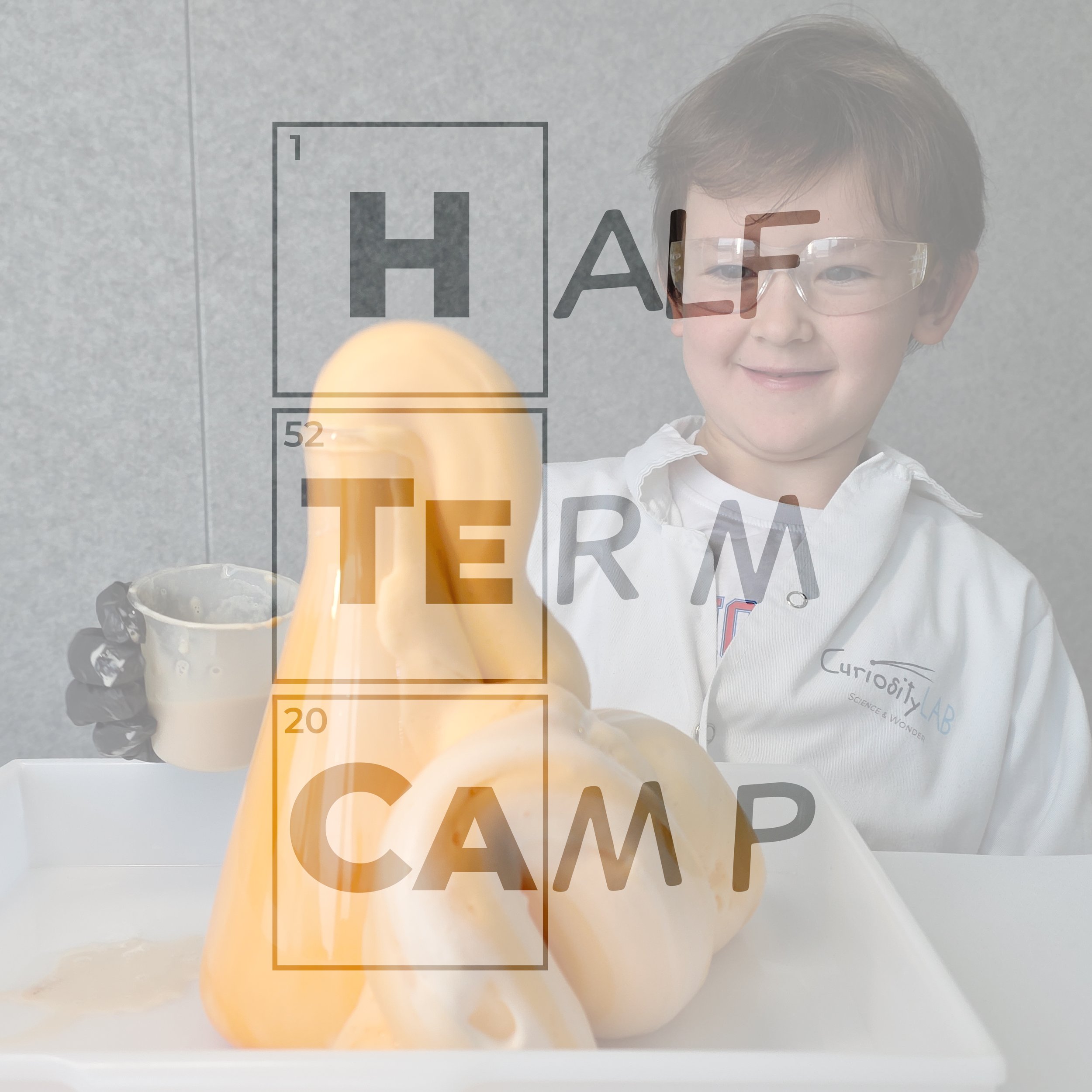
We move across to oxygen, everyone’s favourite element, and with good reason. Without it, it would be a challenge to release all the energy locked away inside chemicals. From the glow of candles to the calories hidden in food, without oxygen, our lives would be cold, dark, and weary. But there are living things that have learnt to do without, and it is one of these that we turn to this week. Using yeast, we will unleash the oxygen trapped within hydrogen peroxide and create the foamy, bubbly mess that is the ever-popular Elephant Toothpaste experiment.